
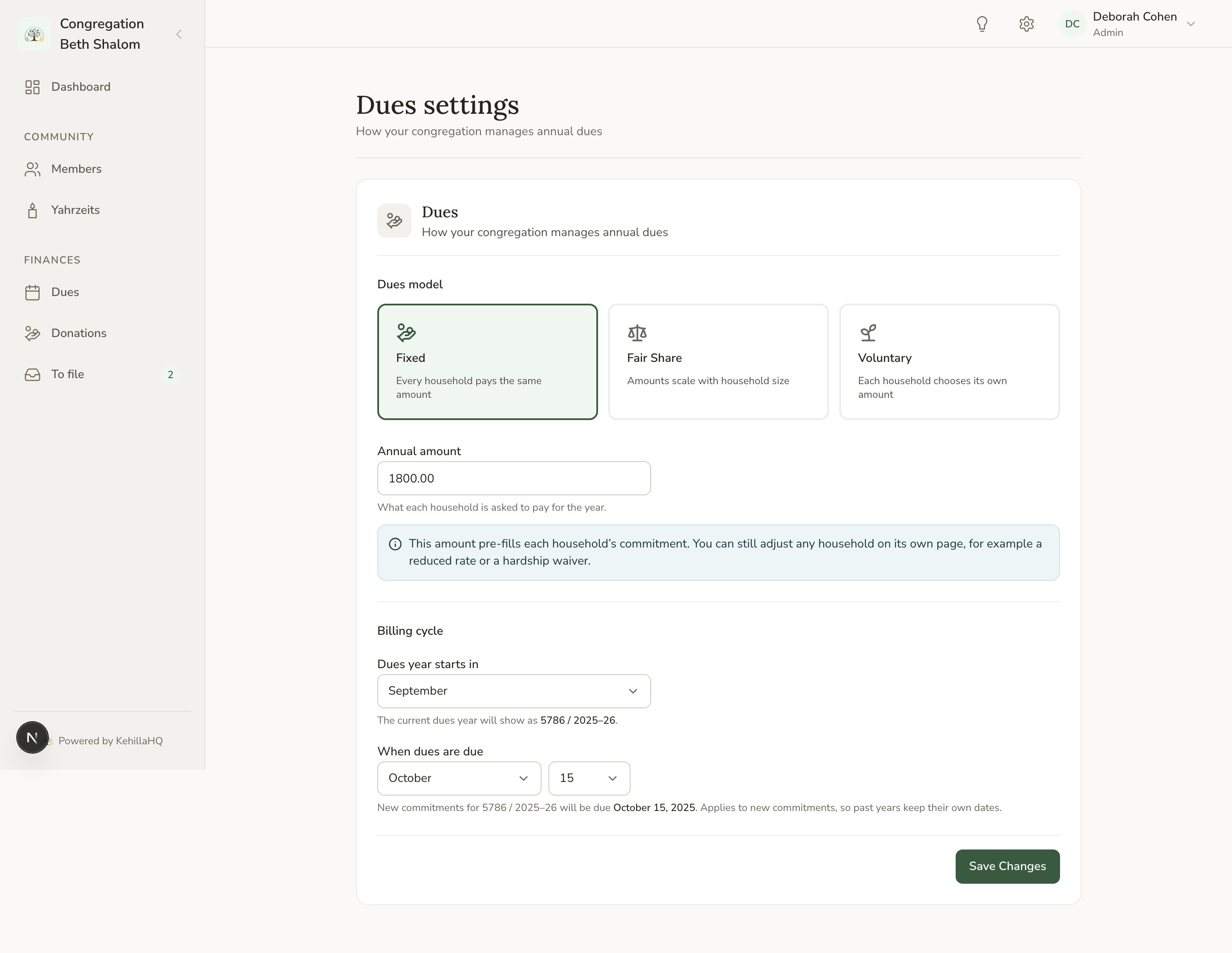
Your dues model
Choose Fixed, Fair Share, Tiered, or Voluntary, and set the amounts that go with it. Each model keeps its own amounts separately, so trying one and returning to another never means retyping your numbers. You can also save a half-finished setup, which is a normal state while you are working things out. See Choosing a dues model.Fair Share brackets
If you are using Fair Share, define your brackets here. Each is set by the smallest household size it covers, and the highest applicable bracket wins. Brackets are described back to you in plain words, for example “1 to 3 adults” or “3 or more adults”, so you can check they say what you intended.When your dues year starts
Set the month your year starts. The default is September. See How dues years work.Your annual due date
A month and a day, used to pre-fill the due date on new commitments. Two behaviours worth knowing: The day is clamped to the month’s length. Setting the 31st means the 28th in February, or the 29th in a leap year. So the 31st is a safe way to say “end of the month”. Changing this never rewrites history. Commitments already recorded keep the due dates they were given, so adjusting the setting cannot retroactively make a past year overdue.Funds
Funds are managed on their own page in the Finances section rather than here. See Funds.Payment connections
PayPal and Stripe connections live under Payments and data sources, separately from dues configuration. See Connecting PayPal and Accepting online payments with Stripe.Setting up from scratch
1
Set your dues year start
First, because everything else is measured against it.
2
Choose your model and enter the amounts
Including brackets if you are using Fair Share.
3
Set your annual due date
So new commitments are pre-filled sensibly.
4
Create your funds
The categories your donations go to.
5
Record commitments
Now the defaults are right, so most households need no adjustment.
6
Connect a payment processor
Last, once the categories exist for payments to be filed into.